Embracing a plant-based diet minimizes the environmental footprint associated with meat production, conserves land and water resources, and lowers greenhouse gas emissions, promoting a healthier planet.
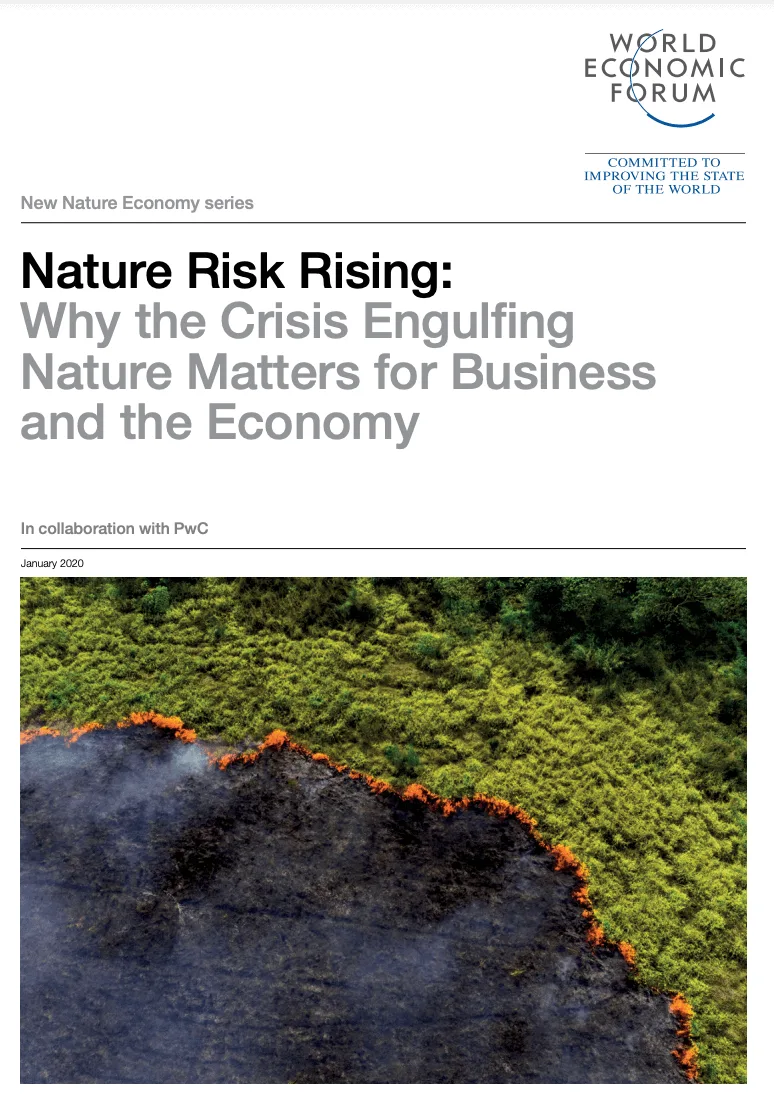
Nature Risk Rising: Why the Crisis Engulfing Nature Matters for Business and the Economy
Nature Risk Rising, produced in collaboration with PwC and the first report in the NNE series, explains how nature-related risks matter to business, why they must be urgently mainstreamed into risk management strategies and why it is vital to prioritize the protection of nature’s assets and services within the broader global economic growth agenda.
About Nature Risk Rising: Why the Crisis Engulfing Nature Matters for Business and the Economy
Look out: Nature Risks on the Rise Nature loss is a planetary emergency. Humanity has already wiped out 83% of wild mammals and half of all plants and severely altered three-quarters of ice-free land and two-thirds of marine environments. One million species are at risk of extinction in the coming decades – a rate tens to hundreds of times higher than the average over the past 10 million years. The World Economic Forum’s 2020 _Global Risks Report_ ranks biodiversity loss and ecosystem collapse as one of the top five threats humanity will face in the next ten years. Human societies and economies rely on biodiversity in fundamental ways. Our research shows that $44 trillion of economic value generation – over half the world’s total GDP – is moderately or highly dependent on nature and its services. Nature loss matters for most businesses – through impacts on operations, supply chains, and markets. We have the power to change this. Humanity urgently needs to rethink its relationship with nature, in order to halt and reverse the alarming degradation of the natural world. Business leaders have a crucial role to play, by putting nature at the core of their processes and decision-making and systematically identifying, assessing, mitigating and disclosing nature-related risks to avoid severe consequences. Businesses can be part of the global movement to protect and restore nature. Despite an increasing focus on nature loss, there is still a limited understanding of why it matters to businesses and what the private sector can practically do about it. The World Economic Forum is launching a series of New Nature Economy (NNE) reports in 2020, making the business and economic case for safeguarding nature. The series aims to catalyse public-private momentum in 2020, with a focus on the UN Convention on Biological Diversity’s milestone summit (COP15) in Kunming, China, and the related Business for Nature mobilization. _Nature Risk Rising_, produced in collaboration with PwC and the first report in the NNE series, explains how nature-related risks matter to business, why they must be urgently mainstreamed into risk management strategies and why it is vital to prioritize the protection of nature’s assets and services within the broader global economic growth agenda.
Reports & documents
Related on Climesumer
Everything else on the site connected to Nature Risk Rising: Why the Crisis Engulfing Nature Matters for Business and the Economy.
Climate actions
Steps this helps you take.
Joining a climate activist group is one of the most effective climate actions. Unlike voting for climate-focused parties, climate activist groups try to accelerate political action by putting pressure on leaders. Sometimes it can feel that climate activist groups want to "take something away" from people. The truth is, they follow the scientific consensus and try to find ways to avoid the worst effects of climate change (which will derail the global economy and life as we know it if we don't act). When you look closely, many of the sustainable alternatives needed for a sustainable and just world like great public transport everywhere, long-distance high-speed trains, heat pumps or even bike friendly cities will improve the life for everyone. Just and fair also means that these changes are made step by step and with low income households and rural areas in mind. They will most likely get more support. There are multiple activism groups to choose from. Some try to disrupt the status quo, some create momentum via political advocacy campaigns or referenda and others try to increase dialogue or try to advance climate solutions on a community level, many have a specific focus like mobility or climate action. ALL of the groups are useful and move the needle in important ways. Choose your pick:)
Choosing a sustainable bank means that your money is doing good and supports the causes you care about while you are asleep. Legacy banks use your money to finance planetary destruction by lending money to evil industries like the fossil fuel, meat and dairy, or weapon industry. Sustainable banks only invest in industries that make the planet and our societies thrive. They invest in renewable energy and other impact industries. Switching your bank is one of the most impactful and easiest climate actions available, that most people don't have on their radar.
Donating empower experts and activists, enhances public awareness, and supports sustainable practices at both local and global levels. By financially backing organisations fighting climate change, individuals can play a significant role in driving progress, influencing policy, and fostering a sustainable future especially if they don't have the time or the ability to be on the ground themselves. Choosing the right organisation is key.
Investing in green funds directs your capital towards sustainable initiatives, such as renewable energy projects and eco-friendly businesses, fostering innovation and driving positive environmental change.
In the Climate Guide
The lessons that put this in context.